Mike Rowe from the series Dirty Jobs talks about reward theory and the dynamic aspect of social economics.
Sunday, March 2, 2014

Sunday, April 21, 2013
John Law
April 21st is the birthday of John Law (1671 - 1729) who came from a wealthy Scottish banking family. Having a great grasp on economics yet allowing vice to bankrupt him, Law figured out a way out of his situation by pairing up with the French royalty who likewise had bankrupted themselves with the king's past war endeavors.
We may recall the 2001 Dot Com Bubble in computer stock trading but stock bubbles are at least 300 years old. Mr. Law tied the French money supply to a central bank and then used stock as paper money which created an investment boom. This scheme came complete with speculation, deflation, stock splits and finally a bust - all in only four years!
This 1978 video about John Law and the "Mississippi Bubble" from Richard Condie details the problems found with compulsive people, irrational behavior, fractional reserve, using law to manipulate the money supply and finally the tendency for underground trade in response to poor central policy.
Law's royal central bank of France, the Banque Générale, still survives today in another form. Some of his economic theories are well noted but one should keep in mind the nature of man when he has control of monetary supply.

We may recall the 2001 Dot Com Bubble in computer stock trading but stock bubbles are at least 300 years old. Mr. Law tied the French money supply to a central bank and then used stock as paper money which created an investment boom. This scheme came complete with speculation, deflation, stock splits and finally a bust - all in only four years!
"The most sensational get-rich-quick scheme in history" courtesy of a central bank and nefarious government leaders.
This 1978 video about John Law and the "Mississippi Bubble" from Richard Condie details the problems found with compulsive people, irrational behavior, fractional reserve, using law to manipulate the money supply and finally the tendency for underground trade in response to poor central policy.
Law's royal central bank of France, the Banque Générale, still survives today in another form. Some of his economic theories are well noted but one should keep in mind the nature of man when he has control of monetary supply.
Saturday, April 20, 2013
Earth Day
For Earth Day 2013 let us look back at this video on endangered species from the Learn Liberty queue.
Additionally we can find more direct economic ties to natural resources in How Capitalism Saved the Whales. A couple of highlights from this post by James S. Robbins:
Additionally we can find more direct economic ties to natural resources in How Capitalism Saved the Whales. A couple of highlights from this post by James S. Robbins:
" In northern climes, whalers sometimes killed blubber-rich arctic seals to augment their oil stores. Both of these animals were saved by the decline of whaling. Oil-drilling in Pennsylvania restored many lakes which had been contaminated by natural petroleum leaks."
"the American whaling industry peaked in the 1850s. The reason for its decline was not because of public awareness of the evils of whaling, it was not because of consciousness-raising efforts by pioneer environmentalists, and it definitely was not because of legislation. The whales were saved because of the march of technology."
emphasis above in bold by this editor
"As kerosene became generally available throughout the country, the demand for whale oil dropped precipitously. The 735-ship fleet of 1846 had shrunk to 39 by 1876."
Friday, March 8, 2013
The Devastating Sequester!
Certainly many of you and your neighbours awoke to a startling mess this week as the U.S. federal government tumbled into a sequestration they designed over a year ago.
Calamity in the cities, havoc on the highway, chaos in the court system as sequestration came to light!!! Eh, well not really so much huh? Even as politicians turned up the heat and pointed fingers.
Let us turn to David Angelo's eEconomics channel for his take on things:
You know you have a comment, go ahead and broadcast it here!
Calamity in the cities, havoc on the highway, chaos in the court system as sequestration came to light!!! Eh, well not really so much huh? Even as politicians turned up the heat and pointed fingers.
Let us turn to David Angelo's eEconomics channel for his take on things:
You know you have a comment, go ahead and broadcast it here!
Sunday, February 17, 2013
The Robin Hood Myth
Another classic from Milton Friedman. This one on why government programs always favor the middle class.
It would be great to see his challenge accepted today:
It would be great to see his challenge accepted today:
"I have often challenged people to find a single governmental program in which the people who pay taxes have higher incomes than those who get the benefits.
I know only one. And that's direct relief public assistance. The aid to families of dependent children. It's not a good program its a terrible program, it's a welfare mess. But so far as I can find out its the only program that demonstrably transfers income from higher income classes to lower income classes, and thats why its such an unpopular program."
Sunday, January 27, 2013
The Impact School Choice Can Make On Lives And Wallets
Consider the wide range of costs in schools today and also the cost for those who do not complete a basic education.
You can find more on the benefits of School Choice at http://www.schoolchoiceweek.com/train
Friday, January 11, 2013
A New Series
Here is the first in what promises to be several two minute installments on basic economic topics.
Perfect for those moments when your school age children are trying to grasp these elements or for your ADHD friends as well.
We can't wait to see more of what Dorian has planned.
Perfect for those moments when your school age children are trying to grasp these elements or for your ADHD friends as well.
We can't wait to see more of what Dorian has planned.
Tuesday, January 8, 2013
National Debt Awareness Day - January 8th
On January 8th, 1835 the U.S. national debt dropped to $0 for the first (and last) time in it's history. Some attribute this instance to President Andrew Jackson's efforts which included allowing the charter for the Second Bank of the United States to expire. But whatever the strategy it has unfortunately never been repeated.
In 2004 our debt was nearly $7 trillion. Only seven years later, January 8th 2011, the amount had doubled to $14 trillion! 2011 was the first National Debt Awareness Day, an effort to draw attention to the fact that massive amounts of debt are being racked up in our name. In other words, the government has a gigantic credit card and politicians are wearing it out; you, the taxpayer, along with future taxpayers get stuck with the payments.
The second NDA day found the debt had risen to $15.2 trillion, and that was after the U.S. Congress supposedly "got serious" about the debt and deficit! At the same time, the president expressed his desire to increase the debt to $16 trillion within a year. Congress accommodated the president and just like clockwork the new debt limit was reached again, no surprise for most.
What is behind all of this debt and how will it be paid when interest payments are already billions of dollars? Politicians focus on the yearly deficit as a way to avoid the massive debt and snowballing interest and future tax burden.
George Washington on debt in his Farewell Address
I hope you enjoy being a part of this occasion - the third annual National Debt Awareness Day! Maybe one day we will have an annual celebration of the 2nd debt free day in the U.S. and find that it will remain that way for many years to come. Interest paid is freedom wasted.
Links about the federal budget and related items:
http://www.usdebtclock.org/ - This has a good breakdown of our debt
http://www.federalbudget.com/
In 2004 our debt was nearly $7 trillion. Only seven years later, January 8th 2011, the amount had doubled to $14 trillion! 2011 was the first National Debt Awareness Day, an effort to draw attention to the fact that massive amounts of debt are being racked up in our name. In other words, the government has a gigantic credit card and politicians are wearing it out; you, the taxpayer, along with future taxpayers get stuck with the payments.
The second NDA day found the debt had risen to $15.2 trillion, and that was after the U.S. Congress supposedly "got serious" about the debt and deficit! At the same time, the president expressed his desire to increase the debt to $16 trillion within a year. Congress accommodated the president and just like clockwork the new debt limit was reached again, no surprise for most.
What is behind all of this debt and how will it be paid when interest payments are already billions of dollars? Politicians focus on the yearly deficit as a way to avoid the massive debt and snowballing interest and future tax burden.
Share this post to let your friends know and promote discussion of National Debt Awareness Day!
George Washington on debt in his Farewell Address
Thomas Jefferson"As a very important source of strength and security, cherish public credit. One method of preserving it is to use it as sparingly as possible, avoiding occasions of expense by cultivating peace, but remembering also that timely disbursements to prepare for danger frequently prevent much greater disbursements to repel it, avoiding likewise the accumulation of debt, not only by shunning occasions of expense, but by vigorous exertion in time of peace to discharge the debts which unavoidable wars may have occasioned, not ungenerously throwing upon posterity the burden which we ourselves ought to bear. The execution of these maxims belongs to your representatives, but it is necessary that public opinion should co-operate. To facilitate to them the performance of their duty, it is essential that you should practically bear in mind that towards the payment of debts there must be revenue; that to have revenue there must be taxes; that no taxes can be devised which are not more or less inconvenient and unpleasant; that the intrinsic embarrassment, inseparable from the selection of the proper objects (which is always a choice of difficulties), ought to be a decisive motive for a candid construction of the conduct of the government in making it, and for a spirit of acquiescence in the measures for obtaining revenue, which the public exigencies may at any time dictate."
"We must not let our rulers load us with perpetual debt. We must make our election between economy and liberty or profusion and servitude. If we run into such debt, as that we must be taxed in our meat and in our drink, in our necessaries and our comforts, in our labors and our amusements, for our calling and our creeds...[we will] have no time to think, no means of calling our miss-managers to account but be glad to obtain subsistence by hiring ourselves to rivet their chains on the necks of our fellow-sufferers... And this is the tendency of all human governments. A departure from principle in one instance becomes a precedent for[ another]... till the bulk of society is reduced to be mere automatons of misery... And the fore-horse of this frightful team is public debt. Taxation follows that, and in its train wretchedness and oppression."
I hope you enjoy being a part of this occasion - the third annual National Debt Awareness Day! Maybe one day we will have an annual celebration of the 2nd debt free day in the U.S. and find that it will remain that way for many years to come. Interest paid is freedom wasted.
Links about the federal budget and related items:
http://www.usdebtclock.org/ - This has a good breakdown of our debt
http://www.federalbudget.com/
Sunday, December 23, 2012
The Washington Shell Game
Follow economist Robert Murphy and see if you can keep up with the shifting funds.
Is it a deficit, a bond, a treasury, keep your eye on the dollar bill folks!
Same thing done here with a pea, rubber ball and tennis ball.
Is it a deficit, a bond, a treasury, keep your eye on the dollar bill folks!
Same thing done here with a pea, rubber ball and tennis ball.
Friday, December 7, 2012
The Reality of Tax Rates and Actual Revenue
A great new find this week, eEconomics! No that isn't a typo, it is the title for David Angelo's YouTube channel. "Regular economics with a modern digital edge."
In his third show here he points out that 1959's 90% tax bracket brought in less than the 2007 bracket of 35% by 1.2.6% of GDP.
Anyone who digs into this more than 30 seconds will find that the income tax rates people commonly talk about don't even begin to factor in on billionaires. A lot is made of Warren Buffet paying so little, and recently Mitt Romney as well, they don't "earn" money - instead they get "capital gains." D'oh! Simply raising the tax bracket to 90% encourages more people who have money to restructure their "work" so they don't pay more money out.
Louis Basenese shows how this went over in England recently in Another Tax Myth Bites the Dust.
And let's finish with Veronique De Rugy's chart showing the last four decades of tax revenue being flat regardless of the TMR being near 50%, 30% or somewhere in between.
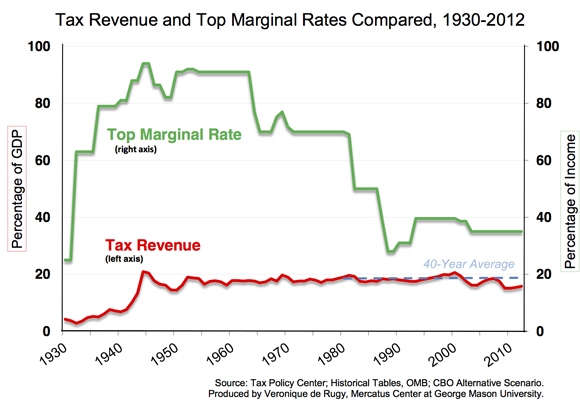
In his third show here he points out that 1959's 90% tax bracket brought in less than the 2007 bracket of 35% by 1.2.6% of GDP.
Anyone who digs into this more than 30 seconds will find that the income tax rates people commonly talk about don't even begin to factor in on billionaires. A lot is made of Warren Buffet paying so little, and recently Mitt Romney as well, they don't "earn" money - instead they get "capital gains." D'oh! Simply raising the tax bracket to 90% encourages more people who have money to restructure their "work" so they don't pay more money out.
Louis Basenese shows how this went over in England recently in Another Tax Myth Bites the Dust.
On April 6, 2010, the top income tax rate in the U.K. jumped from 40% to 50%. The result? The number of people declaring incomes of more than one million pounds plummeted from 16,000 to 6,000, according to The Telegraph.Fast-forward to 2012, and U.K. Chancellor, George Osborne, announced that the top rate would be reduced to 45% in April 2013.Surprise, surprise! “Since the announcement, the number of people declaring annual incomes of more than one million pounds has risen to 10,000,” The Telegraph adds.
And let's finish with Veronique De Rugy's chart showing the last four decades of tax revenue being flat regardless of the TMR being near 50%, 30% or somewhere in between.
Thursday, November 22, 2012
Happy Thanksgiving
An economic perspective on Thanksgiving, with a rather funny narrator.
Share your thoughts on community assets and shared workloads.
Sunday, November 18, 2012
Informed Consumers and Lower Health Care Costs
Recently Paul Krugman touted drug costs under Medicaid as a big win as compared to the hobbled Medicare Part D which is run by private insurors.
One thing missing in the medical market is the price tag. We see direct pricing on everything we need: housing, food, automobiles. Everyone manages to select from cable TV, satellite service and phone company options by listed prices on their entertainment channels and options. Yet few people are engaged in comparing prices when it comes to something as important as medical care. Why is this?
Reason TV brings us a view on what can happen to costs when the consumer gets pricing ahead of time, even if insurance is not involved.
Free market supporters obviously point to the Surgery Center of Oklahoma and Medibid as a direction to investigate. Paul Krugman favors more control from above and less personal involvement. It is for your own good after all...
"Last year a government study compared the prices that Medicaid paid for brand-name drugs with those paid by Medicare Part D — also a government program, but one run through private insurance companies, and explicitly forbidden from using its power in the market to bargain for lower prices. The conclusion: Medicaid pays almost a third less on average."
One thing missing in the medical market is the price tag. We see direct pricing on everything we need: housing, food, automobiles. Everyone manages to select from cable TV, satellite service and phone company options by listed prices on their entertainment channels and options. Yet few people are engaged in comparing prices when it comes to something as important as medical care. Why is this?
Reason TV brings us a view on what can happen to costs when the consumer gets pricing ahead of time, even if insurance is not involved.
Free market supporters obviously point to the Surgery Center of Oklahoma and Medibid as a direction to investigate. Paul Krugman favors more control from above and less personal involvement. It is for your own good after all...
Annie Wilkes administers Dr. Krugman's prescription for fair prices
Saturday, November 3, 2012
Salt In The Wound For Those Affected By Hurricane Sandy
We last brought up the economic aspect of natural disasters back in May, this week Reason.TV brings us word on why there is a gas shortage after Hurricane Sandy wrecked havoc in New Jersey and New York states.
Politicians with good intentions trying to make price controls work proves too tempting for some. It is pretty safe to say that stores would indeed charge more for gas since delivery trucks and fuel storage were also affected by Sandy's destruction. Trucks coming from farther away simply add more to the cost. But would customers be paying twice as much? If stores could charge more would they have more incentive to refill their tanks?
Learn Liberty has this quick study on the ways price bumps can be beneficial during tough times.
Politicians with good intentions trying to make price controls work proves too tempting for some. It is pretty safe to say that stores would indeed charge more for gas since delivery trucks and fuel storage were also affected by Sandy's destruction. Trucks coming from farther away simply add more to the cost. But would customers be paying twice as much? If stores could charge more would they have more incentive to refill their tanks?
Learn Liberty has this quick study on the ways price bumps can be beneficial during tough times.
Friday, November 2, 2012
DO NOT VOTE
P. J. O'Rourke wrote Don't Vote It Just Encourages The Bastards and in the next week we'll re-elect some, toss a few out and at the same time add a fresh batch.
Two years ago he stated "We lost that election, because almost every political contest yesterday was won by a politician. In a couple of cases angry nuts won, which is an improvement over politicians. But it's just no good enough."
Here's a clip of him speaking on the topic and his vision for what would make a better political situation: Kill, Screw, Marry. Economic freedom via the Free Market. "Wrong rights" which kill freedom and what political power is verses freedom.
http://www.c-spanvideo.org/program/296475-1
John Stossel did a segment featuring The Myth of the Rational Voter author Bryan Caplan: Don't Know? Don't Vote!
Now I hope our followers are rational and vote wisely if they do vote... just remember that you're encouraging those bastards. ;) I'm sure you have connected the power of voting to how it relates to economics so share this with your friends who may not have made that connection yet and start the conversation next time you see them!
Two years ago he stated "We lost that election, because almost every political contest yesterday was won by a politician. In a couple of cases angry nuts won, which is an improvement over politicians. But it's just no good enough."
Here's a clip of him speaking on the topic and his vision for what would make a better political situation: Kill, Screw, Marry. Economic freedom via the Free Market. "Wrong rights" which kill freedom and what political power is verses freedom.
http://www.c-spanvideo.org/program/296475-1
John Stossel did a segment featuring The Myth of the Rational Voter author Bryan Caplan: Don't Know? Don't Vote!
Now I hope our followers are rational and vote wisely if they do vote... just remember that you're encouraging those bastards. ;) I'm sure you have connected the power of voting to how it relates to economics so share this with your friends who may not have made that connection yet and start the conversation next time you see them!
Wednesday, October 31, 2012
Choosing Planners
Do we pick a Man of System?
To expand on Adam Smith's The Theory of Moral Sentiments you can read and search the full text here.
Wednesday, October 17, 2012
The Unseen Factors of the Auto Bailout "Success"
The Center for Freedom and Prosperity's Jenna Huhn has posted this response to the great auto company bailout which some people are calling sucessful. What happens when Jenna looks deeper into some of the things Bastiat called the unseen?
We look forward to hearing your thoughts. Are there any other factors you can think of?
More CF&P Econ 101 videos here.
We look forward to hearing your thoughts. Are there any other factors you can think of?
More CF&P Econ 101 videos here.
Friday, September 21, 2012
The Canadian Cure for America's Ailment
Are you suffering from hEaDaChEs related to political faction disputes?
Do large deficits keep you awake all night?
Public debt interest payments eating up your taxes?
If so you may need Sound Fiscal Policy!
The Canadian Remedy for economic woes(TM)
Sound Fiscal Policy has been used successfully to overcome national spending problems. Sound Fiscal Policy can alleviate, even rid you of monetary maladies. Please view this brief video for more information about Sound Fiscal Policy.
Sound Fiscal Policy may cause free riders to whine loudly, subsidized corporations to bleed, and your government to shrink. But it just may be that those side effects are exactly what you need.
Use only under direction of a sensible economist. Beware of fat cat politicians with poor imitations of Sound Fiscal Policy. Do not use in conjunction with Keynesian remedies. For best results use with a flat tax structure and politicians who know when to stop dorking with things they do not understand. You may also experience surpluses, this benefit should be used with ever more wisdom.
Sound Fiscal Policy makes no claim that every application will have equal results but it is probably the best medicine available for your country's ailment.
Wednesday, September 19, 2012
Tuesday, August 21, 2012
The Half-Billion Dollar Garden Sculpture
When I look back at stats for past blog posts it seems that the Billion Dollar Home is always popular.
I think this art project should line up with the Billion Dollar House, I wonder if we could buy them both and install them in one place?
If you ever wondered what was left of Solyndra and the half-billion tax dollars that poured into it prior to going totally bankrupt well now you have

I think this art project should line up with the Billion Dollar House, I wonder if we could buy them both and install them in one place?
If you ever wondered what was left of Solyndra and the half-billion tax dollars that poured into it prior to going totally bankrupt well now you have
Saturday, August 18, 2012
Economic Freedom on the Farm
Farmers have been selling their produce since the early stages of civilization, so just what is going on with vegetables and the authorities in Fauquire County, Virginia? Could this really all be about a birthday party, did someone not invite a special child.
If a person can't raise a crop and sell it to people who want to eat is either party free? How much regulation do local officials need to place on selling farm plants?
If a person can't raise a crop and sell it to people who want to eat is either party free? How much regulation do local officials need to place on selling farm plants?
Subscribe to:
Posts (Atom)